venerdì 22 marzo 2013

I dati di Planck, il fondo cosmico a microonde ed il Big Bang

A quasi quattro anni dal lancio sono stati resi pubblici i primi dati sul fondo cosmico a microonde della sonda Planck. La precisione delle misure consente di determinare con estrema precisione la quantità di materia ordinaria, oscura, e di energia oscura nel nostro universo.  I primi risultati sono stati raccolti in una trentina di articoli che analizzano in dettaglio i vari risultati della missione. Alcuni dati mostrano piccole ma significative discrepante con i valori attesi, e potrebbero aprire la strada verso teorie più precise sulla nascita ed evoluzione del nostro universo.   


Che cos'è e dove si trova Planck? 
Planck è una sonda costruita dall'Agenzia spaziale Europea,  lanciata nel 2010 e  posta in orbita attorno al secondo punto di Lagrange, sul lato opposto della luna rispetto alla terra.  In questa maniera il calore del nostro pianeta non interferisce con le  le misure.


Che cosa misura?
E' un precisissimo termometro che misura la temperatura dell'universo. Questa è in media pari a 2.75gradi  Kelvin, ossia appena  tre gradi sopra lo zero assoluto.
Ogni oggetto emette radiazione elettromagnetica a seconda della sua temperatura; 
 intensità e  frequenza della radiazione emessa sono descritte dalla legge di Planck.
Sia la legge che il satellite sono intitolate al fisico tedesco che la propose 
per la prima volta nel 1900. 
La  formula poté essere derivata solo abbandonando la vecchia concezione 
della meccanica classica 
ed introducendo concetti propri della meccanica quantistica: 
storicamente fu uno dei colpi più duri al  meccanicismo dell'ottocento.
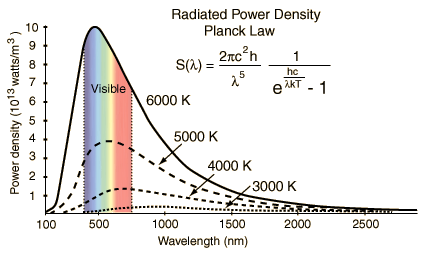
Spettro della radiazione elettromagnetica emesso dal sole (6000 gradi Kelvin) e da altri corpi a temperatura più bassa.
Il picco di emissioni è radiazione visibile ad occhio nudo (in realtà l'occhio umano si è evoluto per essere sensibile alle frequenze di maggiore intensità del Sole).


Le braci incandescenti del camino emettono luce tanto più bianca quanto più alta  è la temperatura.
Abbassando la temperatura le emissioni sono per lo più verso il rosso  (il colore dei carboni ardenti).
Anche il sole emette radiazione secondo questa legge, ad una temperatura di 6000 gradi Kelvin (la temperatura della sua superficie).
In tutti i casi viene prodotta anche radiazione infrarossa, che è quella che ci scalda. Anche gli esseri viventi emettono  radiazione, ma avendo  una temperatura di 37 gradi Celsius,  solo nell'infrarosso (ed è per questo che di notte siamo visibili solo con appositi sensori infrarossi).

Che cos'è la radiazione cosmica di fondo?
Come già accennato, lo spazio intergalattico si trova a 2.75 gradi Kelvin e quindi emette radiazione nelle microonde. Lo spettro - detto anche spettro di corpo nero - è una delle verifiche più accurate della legge di Planck e dell'esistenza del Big Bang.   Questa radiazione è stata emessa 13.78 miliardi di anni fa, quando l'universo aveva solo 379,000 anni e si era raffreddato abbastanza da permettere agli elettroni di essere catturati dai protoni, formando per la prima volta gli atomi di idrogeno. La temperatura e le frequenze emesse a quel tempo erano molto più elevate, ma l'espansione dell'universo le ha fatte scendere sino al valore attuale. 


Spettro della radiazione cosmica di fondo misurato dal pioneristico satellite COBE alla fine degli anni '80.


Ma allora che misura Planck?
Gli strumenti  misurano la temperatura e lo spettro della radiazione emessa in tutte le direzioni della volta celeste. La mappa mostra le fluttuazioni (minime, circa una parte su 10000) dal valore aspettato, in rosso sotto la media e in blu sopra la media. 
Analizzando l'ampiezza e le dimensioni delle oscillazioni è possibile risalire allo stato dell'universo nei suoi primi istanti di vita: se e  quanto fosse uniforme, come si sia scatenata l'espansione, quanta materia ordinaria ed oscura è presente in esso e così via.
Mappa di Planck delle fluttuazioni della radiazione cosmica di fondo (da qui).
I puntini rossi rappresentano le direzioni del cielo dove lo spazio appare
leggermente più caldo, in blu dove è più freddo. La mappa è in coordinate galattiche
per cui la galassia (il cui contributo è stato rimosso) giace  su una riga orizzontale al centro dell'immagine.

I dati  di Planck confermano e raffinano le misure precedenti, mostrando come l'universo si sia espanso improvvisamente per poi proseguire la sua crescita in maniera più graduale, mostrando la presenza di fluttuazioni su grande scala maggiore di quanto previsto dai modelli originali. Lo studio delle implicazioni di queste misure devono ancora venire, ma è auspicabile che - assieme agli studi su LHC - possano aiutare a risolvere alcuni dei più grandi misteri della fisica moderna: natura della materia oscura, significato dell'energia oscura, asimmetria materia-antimateria. Già fare un passo nella soluzione di uno di questi enigmi potrebbe aprire la strada a nuove teorie sulla natura del mondo. 


La distribuzione di materia ed energia nell'universo prima e dopo le misure attuali (da qui)


lunedì 18 marzo 2013

Fukushima two years later: a scientific report (1)

The coast of Minamisoma devastated by the march 2011 tsunami

This post appeared in Italian on wired.it. This is the first part of a (poor) english translation.

March 11, 2013  marked the second anniversary of the earthquake in Tohoku. The event, Mw 9 scale, triggered a huge tsunami on the coast of Northeast Japan. The waves killed more than 18 thousand people, destroyed 50 thousand buildings damaging three times more. The overall damage amounted to tens of billions of euro. In many places the reconstruction was completed but in the worst affected areas - such as the coast of Minamisoma - the few survivors were relocated elsewhere.

The accident of Fukushima-1 nuclear power plant added man-made disaster to nature's destruction. With the first ground vibrations, automatic failsafe systems stopped  the nuclear chain reactions  inserting the control rods in the reactor. However this also stopped the production of energy from the power plant. When - after about an hour - emergency generators were destroyed by the second wave of the tsunami, the cooling water pumps stopped . The residual heat of the fission products, which takes weeks to cool, then  caused the thermal fusion of the fuel rods. This has nothing to do with nuclear fusion but - like many sticks of chocolate left in the sun - has melted the fuel, the control and  the moderator in a single mass, making it extremely difficult, if not impossible, the removal. Without water, the molten core temperature in the reactors had  risen by thousands of degrees reacting with the  inner  zirconium hull, liberating hydrogen, a highly explosive gas that accumulated in the buildings of reactors until it caused the explosion.

Measurements and sample-gathering in the mountains of Fukushima-ken

The main cause of the accident was due to very poor (and criminal) construction choices to save money (sea barriers too low, emergency generators installed in the basement of the buildings and on the sea side, lack of training of employees who were killed by the waves). This procedures were sanctioned and certified by the collusion between the private sector (TEPCO) and the governmental agencies which should have enforced more adequate safeties.

The explosion of the buildings of the reactors of Fukushima plant released large quantities of radioactive material into the environment, mainly Cesium and Iodine. Most has been dispersed in the sea, where the damage is attenuated by the density of the water (a thousand times higher than the air) and the vastness of the Pacific Ocean. Part of it, however -  carried by the winds - has spread on Japan.

Iodine decayed in a few weeks, leaving the cesium-134 and 137 as contaminants of the environment and food. To measure the amount of environmental radiation a Geiger counter is sufficient. This  detector counts all gamma ray striking  it regardless of the gamma energy. The ionization caused by radioactive particles can be traced back to the ambient dose equivalent, measured in mSv / h.

Comparison of different radiation detectors in a hot spot next to a gutter in Fukushima-ken

I recently had the opportunity to go in the region of Fukushima to take measurements of radioactive contamination and collect soil samples and materials. As expected, the average radiation of the region is less than or slightly greater than that of Rome (0.3microSv/h): in the city of Fukushima values ​​are equal to 0.1microSv/h.

The region of Fukushima (and not only) presents however a series of hot spots in which the environmental radioactivity is particularly high: areas with as little as a few tens of centimeters diameter, especially in the vicinity of gutters, under trees, in general where  water or snow, carrying radioactive elements, flow. In the picture is shown a point where the detectors show more than 30 microSv / hour. It is also possible to see that there are considerable differences in the measurements between the detectors: the Russian (blue on the left) and the 'pregnancy-test-like' stick (second from left) were out of scale  due to the high count rates. The discrepancies between the values ​​of the instruments are due to the different type of detector:  gas (Geiger) detect only gamma rays, while the scintillator (usually Cesium Iodide) can also reveal beta and alpha (if they have a appropriately thin window). With 30 microSv / hour, the dose in one year was slightly less than 300 mSv. According to specifications, the average environmental radiation is measured at one meter from the ground (the average height of a man) and is therefore lower (but it should be measured closer to the ground in schools). Even in the unlikely event of living  within 10 cm of the gutter, the values are still lower than those faced by astronauts on the International Space Station.


A large part of the population  has had to  learn to use the counters with competence to compensate  lack of action and moslty lack of confidence in the government. Measurements with a Geiger counter are in fact very simple to perform and characterized the first phase after the accident, where citizens' maps helped in understanding the the amount of radiation and the related environmental risks.

Daily gamma-ray spectroscopy on food samples  at a pre-school.
In blue in the logbook the Cesium region (660 keV)

People are more informed and aware of the risks and effects of radiation than -  for instance - in the area of ​​Tokyo. There is no panic or despair described in some apocalyptic  reports, although it is noticeable a latent concern for the economic and social future of the region. In the absence of adequate support from the central government (the previous majority party was heavily penalized during  last election), many public and private structures took independent actions. Many schools and kindergartens measure the daily amount of radiation in the food served to students. One of kindergartens we visited  had a gamma spectrometer operated with painstaking  care by one of the school cantine. This old Japanese measures the radiation present in the food of the children annotating quantities and characteristics. Over the months he had gained a lot of experience, identifying foods that contain higher amounts of cesium-137, such as mushrooms and renkon, lotus roots. Although below the very strict threshold 100Bq/kq (bananas have 125 Bq / kg of potassium 40), these products were then removed from the school menu.


Even though the direct danger of the radiation is then under control, the economic damage that the incident has caused is considerable: it is difficult to believe that a return to normal will occur in the next future.  The food on sale is below the (stricter than Europe) limit of  100Bq/kg, and therefore perfectly safe and below the doses present in the aforementioned bananas, Brazilian nuts...
Even if food comes  from a non-contaminated area of Fukushima, most of the people and almost all the restaurant owners prefer buying food from other regions. Some promising examples are  measurement performed directly at supermarkets, but it is difficult to estimate how these actually help the overall economy of the region. The signs of economic recovery are evident, but the production is much lower than before the accident. The small financial support has  not prevented numerous suicides among farmers who have lost their jobs.

lunedì 11 marzo 2013

Fukushima due anni dopo, un reportage scientifico


Nell'anniversario dei due anni dal terribile terremoto del Nodr-Est del Giappone, un mio  resoconto dell'incidente alla centrale nucleare di Fukushima e dei suoi effetti su wired.it
L’ 11 Marzo 2013 ricorre il secondo anniversario del terremoto del Tohoku: il sisma, scala 9 Mw, scatenò un enorme  tsunami sulle coste del Nord Est del Giappone. Il maremoto uccise più di 18mila persone, fece decine di migliaia di sfollati, distrusse 50mila edifici e ne danneggiandone il triplo. I danni ammontarono a decine di miliardi di euro. Ove possibile la ricostruzione è stata completata in pochi mesi ma nelle zone più colpite - come la costa di Minamisoma - non è rimasto più nessuno in vita ed i pochi superstiti sono stati rilocati altrove.
Quello che resta della costa di Minamisoma a due anni dallo tsunami
Ai danni della natura si sono aggiunti quelli causati dagli incidenti della centrale nucleare diFukushima-1. Con le prime scosse i sistemi di sicurezza hanno interrotto le reazione nucleari inserendo le barre di controllo ma hanno anche fermato la produzione di energia. Quando – un’ora dopo - i generatori di emergenza sono stati distrutti dall’onda dello tsunami si sono bloccate le pompe dell’acqua di raffreddamento. Il calore residuo dei prodotti di fissione ha quindi fuso le barre di combustibile. Questa fusione non ha nulla a che fare con la fusione nucleare ma – come tanti bastoncini di cioccolato lasciati al sole - ha squagliato insieme le barre di combustibile, di controllo e del moderatore in un’unica massa, rendendone estremamente difficile se non impossibile, la rimozione. Senza acqua e con il nucleo fuso la temperatura nei reattori è salita di migliaia di gradi e il rivestimento interno di zirconio ha scisso liberando idrogeno, un gas leggero e altamente esplosivo che si è accumulato negli edifici dei reattori e ne ha causato l’esplosione, di natura chimica e non nucleare.
La causa principale dell’incidente è da attribuirsi alle errate scelte costruttive improntate al risparmio (basse barriere frangiflutti, generatori di emergenza installati nei semiinterrati lato mare, assenza di addestramento dei dipendenti) ed accettate e certificate da enti governativi di vigilanza collusi con la Tepco e le altre industrie giapponesi.
L’esplosione degli edifici dei reattori della centrale di Fukushima ha liberato nell’ambiente grandi quantità di materiale radioattivo, prevalentemente cesio e iodio. La maggior parte è andata dispersa in mare, dove i danni sono attenuati dalla densità mille volte maggiore dell’acqua rispetto all’aria e dalla vastità dell’Oceano Pacifico. Una parte si è depositata nelle zone vicine alla centrale, mentre il resto - trasportato dai venti – e si è diffuso per lo più verso Nord Ovest e verso il Sud del Giappone.
continua a leggere su wired.it