Visualizzazione post con etichetta radiation. Mostra tutti i post

venerdì 12 aprile 2013

Riken Open Campus, April 20 2013


RIKEN Open Day
Logo of the event

Also this year, the RIKEN open campus will be held Saturday, April 20, 2013 - from 9:00 to 16:00 ( here the link in Japanese). This event, which involves all the laboratories of the institute,wants to show the researches carried out in the fields of physics, biology, medicine, chemistry .... There are both  lectures and experiments be carried out with the participants.
As last year, our laboratory will be involved with a number of lectures on space (in Japanese and English), with 3D video, the use of Fresnel lenses and the model of JEM-EUSO, for the study of cosmic rays from the International Space Station.

Mock-up model of the space telescope JEM-EUSO


Posters on environemntal radiation 
We qill also measure the radiation environment and compare with that of objects of common use.
The RIKEN is located in Wako, Saitama Prefecture, about fifteen minutes from Ikebukuro.


Those who can not participate in the 20, are of course welcome anytime!

giovedì 28 marzo 2013

Fukushima two years later: a scientific report (2) - Gamma spectroscopy


This post appeared in Italian on wired.it. This is the secon part of a (poor) English translation. First part is here

Not only  the food is continuously monitored: also construction wood from the forests of the region is controlled. In this case too the safety limits are much more severe than that of  the volcanic pozzolans often used in the construction of houses and Italian schools.

Monitoring of radiation in a supermarket 10 km
from the coast of Fukushima


Comparison between radiation Italy (Rome) and Japan (Tokyo and Saitama). It is possible to see how radioactive background is higher in Rome than Tokyo. In  Rome the radiation environment is dominated by the peaks of Radon 222. The arrow indicates  where   the Cesium 137 (660 keV) peak should be located.


An estimation of  the amount of Cesium in food, wood or forage requires a spectrometer capable of determining the energy of each gamma ray. Since each isotope emits gamma rays of specific energies, it is possible to determine the quantities of the various isotopes present.

Among the recent devices there is a portable detector consisting of a crystal to stop the gamma  (CsI) and a Silicon Photomultiplier (MMPC or as they call them) to detect the energy measuring the light emitted in the crystal. The simplicity of this type of tools is that they do not require high voltages, are   small as a pack of cigarettes and is used as a USB device. The cost, however, is about 20 times that of a Geiger counter.

A spectrometer can  count, for each decay, the energy of the rays that strike it. In about an hour and then it is possible to obtain a spectrum which describes the type and amount of environmental radiation. To improve the statistics and better highlight the peaks is, however, advisable to wait a while longer. The picture above shows the value measured at Rome in an apartment on the fourth floor: it is 0.25microSv/hour  (with peaks of 0.35).

In the figure above it is possible to see how the spectrum in Rome (and in much of Italy) is dominated by radon 222, a noble gas source to the high amount of environmental radiation. Usually the radon comes from the soil and tuff, but in this case, since it is an apartment on the fourth floor, is more likely to come from pozzolana used in the construction materials . In figure are compared the spectra taken in Rome with those  acquired in Japan. The value of Rome is  higher (0.25microSv / h), followed by the basement workshops of Tor Vergata (0.10 microSv / h, where, however, there is much radon), Kokubunji (0.05), and the fourth floor in Wako (0035 microSv / h). Note the almost total absence of radon in Japan. It is worth mentioning that the environmental radiation at the onsen baths is higher due to the volcanic nature of the sulphurous waters.


Monitoring radiation in wood to be used for construction


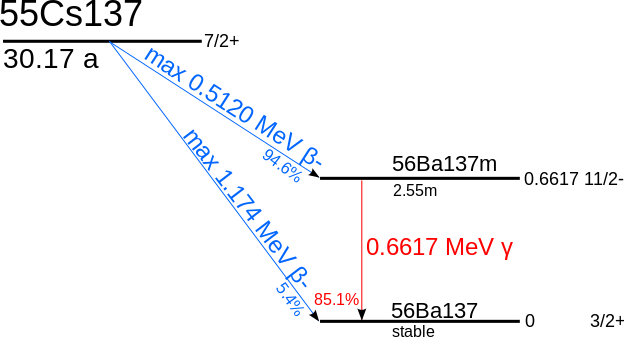
In the samples collected in the hot spots, Cesium-137 is present in large quantities: this isotope decays into an excited state of barium (emitting an electron and an antineutrino). The de-excitation of barium emits a signal characteristic of this element: a gamma ray energy of 660 keV. The process is similar to that of fluorescence, only that in this case atomic electrons are excited. The return to the ground state emits light (between 2 and 3 eV), e.g. electromagnetic radiation. The energy levels in the nucleus are thousands of times more intense and therefore the electromagnetic radiation emitted has an frequency and associated energy thousands of times greater.

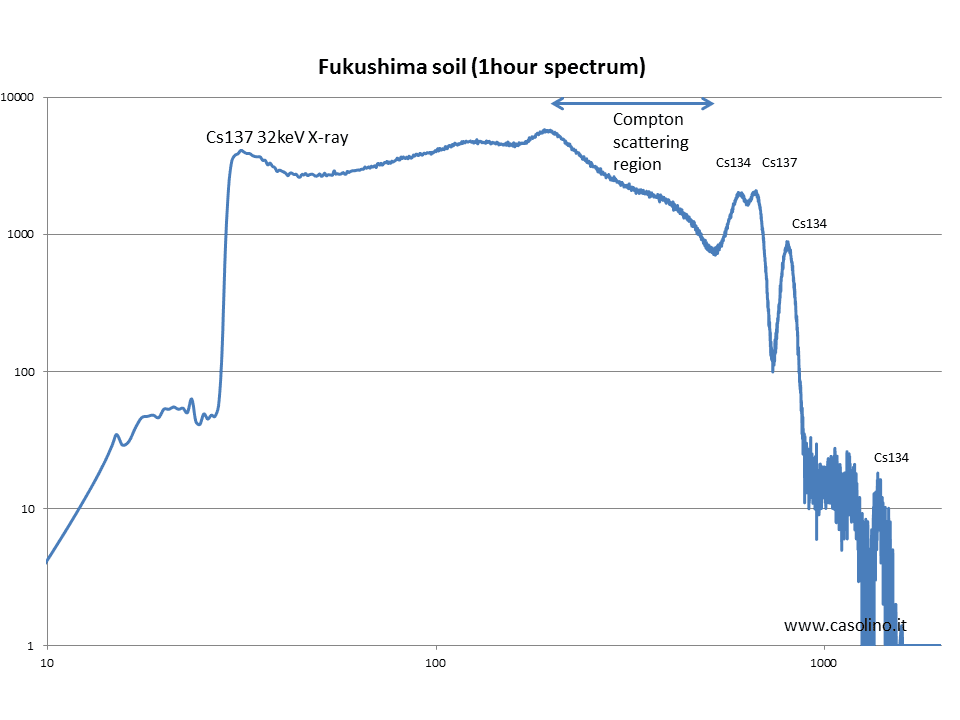
To the left of the peak  there is the so-called 'Compton edge', produced by gamma rays hitting an atomic electron of the Cesium crystal in the detector and accelerating it with a slightly lower energy (depending on the angle with which it is emitted). The spectroscopic analysis of a particularly contaminated sample, taken on  the side of a mountain road between the city of Fukushima and the coast. This sample shows the presence of the isotope cesium-134, which decays into barium with several peaks at 600, 790, 1400 and 1600 keV (the latter is out of range of the detector).

The cesium-134 has a decay time of two years, therefore the presence of this isotope represents the "signature" of the origin of the  Fukushima power plant. In other cases, the absence of cesium-134 was used to show how well mushrooms that had radioactivity above the threshold of 100 Bq / kg were not contaminated by the panel, but presumably from nuclear tests in the ‘60s.

Gamma spectrum from a pure Cs 137 source


Spectrum of a sample of soil containing cesium 134 and 137 of Fukushima region


The measures in the region of Fukushima were extremely interesting, but equally important on a personal level was the contact with the local population. Far from being disheartened, the people in Tohokoku did not give up and have rebuilt many of the structures destroyed by the tsunami. Although the plant has not resulted in deaths due to radiation (morbidly sought by national and international journalists), many deaths are due to poor management of the emergency in the first frantic days after the earthquake. Others are due to suicides after resettlement. The inhabitants of the regions closer to the center have been forcefully moved away and are now rebuilding the social fabric elsewhere, so sometimes it is difficult to return to their town of origin, even if it were decontaminated. The most relevant problem is economic: the damage to the primary sector and tourism are visible to all and will require years to get back to normal.

2. end  First part is here

lunedì 18 marzo 2013

Fukushima two years later: a scientific report (1)

The coast of Minamisoma devastated by the march 2011 tsunami

This post appeared in Italian on wired.it. This is the first part of a (poor) english translation.

March 11, 2013  marked the second anniversary of the earthquake in Tohoku. The event, Mw 9 scale, triggered a huge tsunami on the coast of Northeast Japan. The waves killed more than 18 thousand people, destroyed 50 thousand buildings damaging three times more. The overall damage amounted to tens of billions of euro. In many places the reconstruction was completed but in the worst affected areas - such as the coast of Minamisoma - the few survivors were relocated elsewhere.

The accident of Fukushima-1 nuclear power plant added man-made disaster to nature's destruction. With the first ground vibrations, automatic failsafe systems stopped  the nuclear chain reactions  inserting the control rods in the reactor. However this also stopped the production of energy from the power plant. When - after about an hour - emergency generators were destroyed by the second wave of the tsunami, the cooling water pumps stopped . The residual heat of the fission products, which takes weeks to cool, then  caused the thermal fusion of the fuel rods. This has nothing to do with nuclear fusion but - like many sticks of chocolate left in the sun - has melted the fuel, the control and  the moderator in a single mass, making it extremely difficult, if not impossible, the removal. Without water, the molten core temperature in the reactors had  risen by thousands of degrees reacting with the  inner  zirconium hull, liberating hydrogen, a highly explosive gas that accumulated in the buildings of reactors until it caused the explosion.

Measurements and sample-gathering in the mountains of Fukushima-ken

The main cause of the accident was due to very poor (and criminal) construction choices to save money (sea barriers too low, emergency generators installed in the basement of the buildings and on the sea side, lack of training of employees who were killed by the waves). This procedures were sanctioned and certified by the collusion between the private sector (TEPCO) and the governmental agencies which should have enforced more adequate safeties.

The explosion of the buildings of the reactors of Fukushima plant released large quantities of radioactive material into the environment, mainly Cesium and Iodine. Most has been dispersed in the sea, where the damage is attenuated by the density of the water (a thousand times higher than the air) and the vastness of the Pacific Ocean. Part of it, however -  carried by the winds - has spread on Japan.

Iodine decayed in a few weeks, leaving the cesium-134 and 137 as contaminants of the environment and food. To measure the amount of environmental radiation a Geiger counter is sufficient. This  detector counts all gamma ray striking  it regardless of the gamma energy. The ionization caused by radioactive particles can be traced back to the ambient dose equivalent, measured in mSv / h.

Comparison of different radiation detectors in a hot spot next to a gutter in Fukushima-ken

I recently had the opportunity to go in the region of Fukushima to take measurements of radioactive contamination and collect soil samples and materials. As expected, the average radiation of the region is less than or slightly greater than that of Rome (0.3microSv/h): in the city of Fukushima values ​​are equal to 0.1microSv/h.

The region of Fukushima (and not only) presents however a series of hot spots in which the environmental radioactivity is particularly high: areas with as little as a few tens of centimeters diameter, especially in the vicinity of gutters, under trees, in general where  water or snow, carrying radioactive elements, flow. In the picture is shown a point where the detectors show more than 30 microSv / hour. It is also possible to see that there are considerable differences in the measurements between the detectors: the Russian (blue on the left) and the 'pregnancy-test-like' stick (second from left) were out of scale  due to the high count rates. The discrepancies between the values ​​of the instruments are due to the different type of detector:  gas (Geiger) detect only gamma rays, while the scintillator (usually Cesium Iodide) can also reveal beta and alpha (if they have a appropriately thin window). With 30 microSv / hour, the dose in one year was slightly less than 300 mSv. According to specifications, the average environmental radiation is measured at one meter from the ground (the average height of a man) and is therefore lower (but it should be measured closer to the ground in schools). Even in the unlikely event of living  within 10 cm of the gutter, the values are still lower than those faced by astronauts on the International Space Station.


A large part of the population  has had to  learn to use the counters with competence to compensate  lack of action and moslty lack of confidence in the government. Measurements with a Geiger counter are in fact very simple to perform and characterized the first phase after the accident, where citizens' maps helped in understanding the the amount of radiation and the related environmental risks.

Daily gamma-ray spectroscopy on food samples  at a pre-school.
In blue in the logbook the Cesium region (660 keV)

People are more informed and aware of the risks and effects of radiation than -  for instance - in the area of ​​Tokyo. There is no panic or despair described in some apocalyptic  reports, although it is noticeable a latent concern for the economic and social future of the region. In the absence of adequate support from the central government (the previous majority party was heavily penalized during  last election), many public and private structures took independent actions. Many schools and kindergartens measure the daily amount of radiation in the food served to students. One of kindergartens we visited  had a gamma spectrometer operated with painstaking  care by one of the school cantine. This old Japanese measures the radiation present in the food of the children annotating quantities and characteristics. Over the months he had gained a lot of experience, identifying foods that contain higher amounts of cesium-137, such as mushrooms and renkon, lotus roots. Although below the very strict threshold 100Bq/kq (bananas have 125 Bq / kg of potassium 40), these products were then removed from the school menu.


Even though the direct danger of the radiation is then under control, the economic damage that the incident has caused is considerable: it is difficult to believe that a return to normal will occur in the next future.  The food on sale is below the (stricter than Europe) limit of  100Bq/kg, and therefore perfectly safe and below the doses present in the aforementioned bananas, Brazilian nuts...
Even if food comes  from a non-contaminated area of Fukushima, most of the people and almost all the restaurant owners prefer buying food from other regions. Some promising examples are  measurement performed directly at supermarkets, but it is difficult to estimate how these actually help the overall economy of the region. The signs of economic recovery are evident, but the production is much lower than before the accident. The small financial support has  not prevented numerous suicides among farmers who have lost their jobs.

lunedì 4 marzo 2013

Radioactivity and Cesium in Fukushima soil with gamma spectrometers


(Italian version of this post is here)

Collection of samples in the region of Fukushima
The accident at the Fukushima-1 released large quantities of radioactive material in the air: this is now dominated by radioactive isotopes of Cesium-137 and -134. In a previous post we  compared  measurements of environmental radioactivity, showing how the radiation background  in Rome is higher than in Tokyo.


Spectrum of a source of pure cesium-137

The figure shows the spectrum of gamma rays emitted by an artificial source of cesium-137 acquired with the same spectrometer described in the previous post.The cesium decays into an excited state of barium (emitting an electron and an antineutrino). The de-excitation of barium emits a gamma ray energy of 661 keV. This process is similar to fluorescence, except that this phenomenon is due to excited atomic electrons. The return of the electrons to the ground state emits light (between 2 and 3 eV), that is  electromagnetic radiation. In fluorescence the energy levels in the nucleus are thousands of times more intense and therefore the electromagnetic radiation emitted has an energy thousands of times greater.
To the left (lower energy) of the 661 keV peak you have the " Compton shoulder ", produced by gamma rays hitting and producing an electron  with lower energy than the primary gamma, depending on the angle with which it is issued.
On the far left there is also a peak at 30 keV is also due to the emission of X-ray excitation of barium.

The spectroscopic analysis of a sample of soil in the region of Fukushima collected in January 2013 shows a more complex structure. In this case it is a particularly contaminated sample, took the side of a mountain road between the city of Fukushima and the coast . Other samples are not so active. Presumably the deposition of water and snow did accumulate large amounts of cesium on the edge of the road. As already described in other posts, the eplosions at plant has emitted reactor also cesium-134 which decays into barium with peaks at 600, 790, 1400 and 1600 keV (the latter is out of range of the detector). Each gamna has its Compton shoulder associate: the sum of the various emission produces the characteristic spectrum shown in the figure.

File: Cs-137-decay.svg
Decay pattern of cesium-137 ( from here )
It should be recalled that the cesium-134 has a decay time of two years, for which the presence of these peaks denotes the origin of Fukushima. In other cases the absence of cesium-134 has been used to show how fungi which also had radioactivity above the threshold of 100 Bq / kg were not contaminated by the central, but presumably from previous nuclear tests.

Gamma spectrum emitted by a sample
soil of Fukushima region.
From the decay probabilities  and the height of the peaks can be traced to the relative abundances of different isotopes. Reconstructing the absolute activity of a given sample in Bq / kg is much more complicated because it is necessary to take into account the geometry and efficiency of the detector: it will be the subject of a future post.

venerdì 15 febbraio 2013

Radon from Rome, Cesium from Fukushima: environmental radiation and gamma spectroscopy


The detector C12137, at the bottom right in the photo. 
(iaIt connects via USB to the computer for the acquisition
(Italian version here)
The Fukushima accident released large quantities of radioactive materials in the environment, especially iodine and cesium. Iodine decayed in  a few weeks, leaving  cesium-134 and 137 as potential contaminants of the environment and food. A Geiger counter is sufficient to measure the amount of environmental radiation. This detector, however, counts indistinctly each gamma ray that hits it, regardless of the energy of the particles.To estimate the amount of cesium in the environment (and especially in food) is necessary a spectrometer, capable of determining the energy of gamma rays. Since each isotope emits gamma rays of specific energies, from the analysis of the peaks, it is possible to determine the amount  of the various isotopes present.
Recently, Hamamatsu photonics, a company specializing in the development of detectors for space physics, particle and medical devices, has released a portable detector ( C12137) with a crystal to stop the gammas (CsI) and a Silicon Photmultiplier (or a MMPC as they call them) to reveal the energy by measuring the emitted light . The simplicity of this relatively new detector, invented by a Russian scientist, is that it does not requires high voltages, is as small as a pack of cigarettes and you can connect to any USB port. As all  spectrometers,  however, the cost is about 20 times that of a Geiger counter.

The  picture above   shown the radiation in Rome, in a fourth (fifth by Japanese counting) floor apartment: it is 0.25microSv/hour (with peaks of 0.35).
As mentioned, the advantage of the gamma spectrometer, however, is to count, for each decay, the energy of the rays that hit him. In about an hour and then it is possible to obtain a spectrum which describes the type and amount of ambient radiation. To improve the statistics and better highlight the peaks is, however, advisable to wait a while longer. In the figure below you can see how the spectrum in Rome (and in much of Italy) is dominated by radon 222, a noble gas source to the high amount of environmental radiation. Usually the radon comes from the subsoil and from tuff, but in this case, being a flat on the fourth floor, is more likely to come from pozzolanas of construction materials. 

Spectrum of the radiation environment in a home 
of Rome. The peaks of radon 222 are clearly visible. 
Spectrum of an hour equivalent averaged over 7 hours

The figure below compares two spectra  taken in Rome with two acquired in Japan. The value of Rome is the higher (0.25microSv /h), followed by the basement laboratories of Tor Vergata University in Rome(0.10 microSv / h, where, however, there is not much radon), Kokubunji (0.05), and the fourth floor in Wako (0035 microSv / h).Note the almost total absence of radon in Japan (in the onsen, however, may be  higher). The peak at 1460 keV is probably due to Potassium 40 (aka Calium - the same present  in bananas).
Radiation comparison between Italy and Japan. 
The radioactive background is higher in Rome than in Tokyo

The arrow marks the 660 keV regiorn where   the peak of cesium 137 should be located: as is evident there are no measurable quantities of this species above the bottom of the radiation environment. 

Cesium can be detected detected in various hotspots in the region of Fukushima and in soil samples: this topic will be discussed in a next post.

(1) continues
Previous post on this topic in english:

Let's measure Radiation: the radioactivity of everyday objects 放射線を測って見よう (also in Japanese)


Survivalism and the real radiation contamination in Japan


sabato 26 gennaio 2013

La contaminazione in GIappone: Appunti da Fukushima (2)

Test del cibo in un punto vendita della coop.
Lo spettrometro si trova alla destra della foto,
il cibo viene inserito nel cassetto di cu si vede
la maniglia. I risultati delle analisi sono stampati
e consegnati ai clienti. Il negozio vende per lo più cibo
prodotto nella regione di Fukushima.
A giudicare dal numero di clienti, l'impressione è che
l'iniziativa abbia un buon successo.
Il punto vendita si trova in una zona distrutta dallo tsunami,
in prossimità di Minamisoma. (Impressionante l'ampia distanza
che ci separava dal mare) 
La regione di Fukushima (e non solo) presenta una serie di hot spot in cui la radioattività è particolarmente elevata: queste zone sono spesso delle dimensioni di poche decine di centimetri, in prossimità di grondaie, sotto gli alberi, e in generale dove si raccoglie l'acqua o la neve. In foto una zona dove i rivelatori mostrano più di 30 microSv/ora. E' possibile vedere come vi siano considerevoli differenze tra i rivelatori: quello russo (blu a sinistra) e quello a stick (secondo da sinistra) erano fuori scala, essendo costruiti per bassi fondi. LE discrepanze dei valori degli altri strumenti sono dovuto al diverso tipo di rivelatore: quelli a  gas (contatori Geiger) hanno una risposta solo ai gamma, mentre quelli a scintillatore (di solito ioduro di cesio) possono rivelare anche beta e alfa (se hanno anche una finestra opportuna). Con 30 microSv/ora, la dose in un anno ammonterebbe a poco meno di 300 mSv. Questo nell'improbabile ipotesi che si viva sempre nei 10 cm della grondaia, per cui non si tratta di valori preoccupanti (peraltro inferiori a quanto sono soggetti gli astronauti sulla stazione spaziale). 


Hot spot  in prossimità di una grondaia

Il monitoraggio delle radiazioni è comunque molto distribuito e le persone - seppur non specialisti - usano gli strumenti con competenza,  sia che si tratti di strumenti posti nelle segherie che nelle coop che vendono prodotti di Fukushima. Val la pena ricordare che la soglia di sicurezza del legno da costruzione è comunque molto inferiore a quella peraltro assente - dato che non si fanno controlli - delle pozzolane vulcaniche italiane. Nel caso del cibo, i prodotti in vendita sono tutti sotto i 100Bq/kg, e dunque perfettamente sicuri. Tuttavia la produzione nella zona è crollata con la fiducia dei consumatori. Ad esempio i ristoratori non possono utilizzare prodotti dell regione anche se li reputano sicuri. I segnali di ripresa sono evidenti, ma si tratta comunque di una frazione della produzione prima dell'incidente. 

Raccolta di campioni in un altro hot spot
in prosismità di un parcheggio tra Fukushima città
e la costa. Si noti lo spettrometro portatile (scatola bianca)
collegato al computer. I picchi del Cesio sono sulla destra dello schermo.


sabato 30 giugno 2012

Let's measure Radiation: the radioactivity of everyday objects 放射線を測って見よう

This post is based on a stand the JEM-EUSO group  prepared for RIKEN open campus, in April 2012. 


The poster prepared fo RIKEN open campus 2012. Click to enlarge
Special thanks to I. Kaneko for the graphic layout and to H. Miyamoto
for the Japanese translation.


Polonium creeps into tobacco
Tobacco is the single largest source of radiation affecting to man, both in Europe and Asia and worldwide. In fact cigarettes contain polonium-210, which accumulates on the tobacco leaves due to the fertilizer used, apatite, which also includes radium and lead-210.Smoking, polonium is deposited at bifurcations of the bronchi with the lungs, one of the places where they originate many of the cancers of smokers.
Smoking a pack of cigarettes a day, we are exposed to 100 mSv each year (compared to a threshold of 15mSv and an average of 1mSv). Consequently the risk of getting cancer is 25 times greater than those subject only to environmental radon. Note that these figures are for deaths due to radiation and do not include those for cancer directly caused by carcinogenic substances in the smoke. Moreover, the tar in cigarette smoke also has the effect of fixing the particles of radon in the lungs by preventing the body to eject the radioactive material  and increasing the damage compared to a non-smoker who is exposed to the same quantity of radon. It is estimated that every year in Europe, a tenth of deaths from lung cancer, about 20,000 cases are due to exposure to radon and polonium. From these estimates we can conclude that fifty years of smoking have caused – only for the radiation component - a million deaths in Europe.
In detail, the probability of contracting lung cancer before 75 years at concentrations of 0, 100 and 400 Bq/m3 radon is equal to, respectively, 0.4%, 0.5% and 0.7% for non-smokers. For those who smoke a pack of cigarettes a day the risk rises to 10%, 12% and 16%. An estimated 20,000 deaths in Europe each year from lung cancer are due to exposure to radon (9% of all deaths from lung cancer, representing 2% of deaths from all cancers). 

肥料からポロニウムを吸収 
タバコは単体で人体に最大の影響を及ぼす放射線源で、その影響はヨーロッパやアジア、世界各国に及びます。
タバコを製造する際に使用するタバコの葉には放射性物質が含まれています。特にポロニウム210やラジウム、鉛210を含んでいて、そのほとんどが土壌と肥料から吸収したものです。
喫煙により、ポロニウムは肺につながる気管支の分岐に蓄積されます。喫煙者のがんの多くが発症する部位の一つです。

たばこを1日1箱吸うと、1年間に100ミリシーベルトの放射線を浴びることになります(法で定められた年間許容量は20ミリシーベルト、日本の平均自然放射線量は1ミリシーベルト)。結果として、自然界のラドンからの放射線のみを浴びている場合と比べてがんになるリスクが25倍になります。ただし、これらの図は放射線による死亡率を表したもので、タバコに含まれる発がん性物質によるがんは含まれていません。更にタバコの煙に含まれるタールは放射性物質を体外に排出する働きを妨げるため、肺の中のラドンの粒子を固定し、同量のラドンに曝された非喫煙者に比べて、よりダメージが大きくなります。ヨーロッパでは毎年肺がんによる死亡件数のうち10%に当たる2万人がラドンやポロニウムの放射によるものであると見られています。これらの見積もりから50年間の喫煙による志望者数は(放射性物質によるものだけで)ヨーロッパにおいて 100 万人に上ることになります。
より詳しく述べると、75歳以下の肺がんの発症率は、非喫煙者の場合、1立方メートル当り0、100、400ベクレルのラドンに被ばくした場合、それぞれ全体の0.4%、 0.5%、 0.7%なのに対して、喫煙者の場合はリスクがそれぞれ10%、 12%、 16%に上がります。ヨーロッパにおける年間2万件の肺がんによる死亡推定件数はラドンの被ばくによるものです(肺がん死亡件数のうち9%がラドン被ばくによるもので、これは全てのがんによる死亡率の2%にあたります)


Food

All food contains small amounts of radioactive material: for instance  bananas contain about 125Bq/kg of potassium-40 (which means that a kilogram of bananas contains 125 Potassium nuclei that decay each second). Brazil nuts can contain up to 260 Bq/kg of radium. Currently all food limits are at 100 Bq/kg or below for cesium. It should be noted that there may be a difference in the total dose depending on the speed of the various radioactive substances are expelled from the body (for example, the potassium is removed rela

tively fast, while cesium may remain in the human body for a longer period).


私たちが普段口にする食べ物は全て微量の放射性物質を含んでいます。例えばバナナは1kg当り125Bqのカリウム40を含んでいます(バナナに含まれるカリウムは、毎秒1kg当り125個ずつ崩壊しながら放射線を出します)。同様にブラジルのナッツには1kg当たり260Bq以下のラジウムが含まれています。現在全ての食物において、セシウムの含有量は  1kg当り100Bq以下に制限されています。ここで注意しなければならないのは、取り込まれた放射性物質が私たちの体から排出されるまでの時間によって、私たちの体が浴びる総放射線量が変わるということです(例えば、セシウムが長く体内に留まるのに対して、カリウムは比較的早く体外に排出されます)。


lunedì 30 aprile 2012

Nuclear Plants, Radiation and Food in Japan - updates

Currently in English, Italian translation will follow. 

Power Production

No electricity is generated from nuclear plants in Japan. All but one reactors are down, officially for maintenance. Whether they will be reactivated is still debated. Oki reactors are now less likely to be put back on line, pending the complaints by local government and some still unclear safety issues.

As of now, both Kanto and Kansai (that are on different grids) are consuming about 80% of the full power production. If this figures are correct, there is the clear possibility to have scheduled black-outs this summer, especially if it will be warmer than last year. The situation might be more critical for Kansai  which had a larger nuclear-produced energy fraction and that last summer had still the nuclear power plants online. 

Environmental radiation in case of no decontamination
in 10 and 20 years from now


Environmental radiation


Outside the exclusion zone, Japan has  an average  lower environmental radiation than Italy.  
Recent simulations show that - in absence of any decontamination - the Fukushima expelled Cesium will leave the exclusion zone unsafe for more than 10 years. This is hardly surprising given the 30 years half-life of Cesium 137. Decontamination strategies are under study, either by removing the ground, by letting radiation penetrate deepen in the soil in case of hot spots, or by physically separating the radioactive material from the rest. A truck from Toshiba has been set up to demonstrate the principle. The first method seems more expensive but is much more reasonable,  provided that all the material is stored around the site of the now destroyed power plant. The truck option would be the cleanest one, but cost of the procedure and the possibility of large scale production are not clear. 


Is there radiation in food in Japan?

A vegetable wholesaler has been found relabeling the origin of Fukushima cucumbers in other prefectures. He was just scolded, no fine or charges. The cucumbers were not dangerous in themselves, since it still is below the new limit of 100Bq/kg for Cesium, but the lack of legislation is worrying. This new lower limit (previously was 500Bq/kg) is causing a lot of trouble to fruit and vegetable companies, since the value is extremely low too meet. .  All food (and our body) contains radioactive material: as a reference it is worth remembering that bananas  have 125 Bq/kg of  Potassium 40 (even though it is expelled faster from the huma. body).


Left and right: radiation data of Coop food products

All are below the new limit of 100Bq/Kg (mentioned in the top page). The food with highest radiation content are Shiitake mushrooms. Note that Germanium detectors have an higher resolution than those of NaI  and can distinguish between the isotopes of Cs134 and Cs137. 
The total amount of radiation in Ge-measured products is the sum of the two isotopes. Cs134 has a shorter half-life, two years, compared to the 30years of Cesium 137, so it is expected that Cs134 content will be negligible by next year.


Rate of disappearance of Cesium from human body
from here
 

mercoledì 18 aprile 2012

Survivalism and the real radiation contamination in Japan

Japan is catching up with the tradition of bad newspaper articles, depicting an apocalyptic,  post-nuclear vision of the life in the  island. If the term "post-nuclear" might apply to a country that has all but one nuclear reactors off the power production grid, many of the personal views expressed in one recent article were especially puzzling. This is an excerpt of the letter I sent to the editors of the daily newspaper. I hope it might be a useful recap of the situation in Japan. The letter did not contain the links (that unfortunately are in italian, but google translate does a decent job).


Dear Sirs,

in reading your article [...] I cannot help but be puzzled by the content and implications.  
[...] in the article there is no mention of real measurements of environmental or food contamination,  only hearsay and very general and unhelpful comments that would probably better find its place in a personal blog rather than on a daily newspaper that is widely read by the foreign community in Japan and by foreigners that are interested on Japan.
The risk in reading the personal comments and life-style expressed in the article is that all foreigners are mindlessly scared about radiation and/or  that the situation of the radiation in Japan after the Fukushima accident is out of control.
As you might be aware, the foreign press in general, and in particular the Italian one, has been extremely inaccurate and unprofessional in dealing with the accident, its effects and the risks of radiation in Japan and abroad.   This kind of old-maid’s tale articles can be misinterpreted or voluntarily misused by foreign press to depict an incorrect situation in Japan and on the people -  foreigners or not -  living in this country.
Some points that are worth remembering,  at least  to ease the worries of the author:

1.       Radiation in Tokyo area is roughly one third than in Rome (0.1 microSv/h vs 0.3microSv/h and 0.4 at the University of Rome Tor Vergata, near volcanic rocks – personally measured)

2.       Radiation on airplanes is 20 times higher than on the ground. Even though we spend less time on an airplane this is relevant for airline crews.

3.       Radiation in space is 1000 times higher than on ground. No ill effect have been found on astronauts who lived  for months on the International Space Station.

4.       Bananas have 125 Bq/kg of radioactive potassium 40 (higher than the Cesium safety levels of 100 Bq/kg).  It is possible that the process of eliminating cesium and potassium is different, though. (edit May 2012, here  the time of permanence of Cesium in human body).

5.       The amount of food consumed comes into play in calculating the radiation exposure.  Five grams of “radioactive” tea, even assuming  the old limit of 500Bq/kg amount to 0.5 Bq.

6.       A number of independent measurements point to no risk in the food, my colleagues in Italy have tested personally the amount of cesium in rice of Miyagi-ken and found 0.1 Bq/kg, less than 1per mil of what found in bananas.

7.        Chernobyl and Fukushima are two completely different accidents: in the former case the reactor core was exposed and radioactivity was dispersed in the air. This did not happen in Fukushima plant, where most of the radiation went in the water.

8.       Cigarettes contain polonium 210 (the same isotope used to kill the Russian dissident Litvinienko), present in the tobacco due to fertilizers. A two pack per day smoker is exposed to 250 mSv/year in the bronchial region, compared to about 1-3mSv/year of non-exposed persons.  In Europe, every year 5000 people die because of radiation induced cancers in the lungs (this is about 15% of all cancers in lungs).

9.       The highest risk of radiation in Europe is due to radon gas seeping through the underground cracks. This radioactive , but chemically inert gas, can accumulate in places where air is not changed often. 

At this point it should be mentioned that I have been living with two small children and a Japanese wife since before the fateful earthquake and accident at the power plant, and that, even though we took precautions and monitor closely the situation, we do not live in the state of fear that might be mistaken to be typical of foreigners in Japan. The same can be said of my colleagues, Japanese and foreigners  at RIKEN  and the many foreigners living in Japan, equally puzzled by the tone of the article and the discrepancy with their daily lives and behavior.  
This is not to attempt to deny the tragic events of the accident and its devastating implications, but to put them in the correct context and to analyze the situation individually and independently with real measurements.  This is the effort that has to be painstakingly pursued by everyone.  
My main research field is space physics with satellites and radiation environment studies on astronauts, but I am also struggling – for what is possible – to inform on the real situation and correct the excesses and apocalyptic visions that have been evoked in my country since the Fukushima accident.  [...]  
I sincerely hope that – in line with your excellent editorial policy and quality of the articles  that have kept us informed of the situation in Fukushima - of you might publish in the future a “review” article with more circumstantiated numbers, values and  reading, but also on the life in daily Japan,  so that the general public can be made aware of the current situation. If possible, please print the main points of this letter on your newspaper.
yours sincerelly....


-------------
It might be worth adding that very cheap and relatively precise geiger counters are available from many shops. Radiation is one of the most easily measurable quantities, also by non-specialists. If you have doubts, it is very easy to make your own measurements.