Visualizzazione post con etichetta nuclear power plant. Mostra tutti i post

lunedì 4 marzo 2013

Radioactivity and Cesium in Fukushima soil with gamma spectrometers


(Italian version of this post is here)

Collection of samples in the region of Fukushima
The accident at the Fukushima-1 released large quantities of radioactive material in the air: this is now dominated by radioactive isotopes of Cesium-137 and -134. In a previous post we  compared  measurements of environmental radioactivity, showing how the radiation background  in Rome is higher than in Tokyo.


Spectrum of a source of pure cesium-137

The figure shows the spectrum of gamma rays emitted by an artificial source of cesium-137 acquired with the same spectrometer described in the previous post.The cesium decays into an excited state of barium (emitting an electron and an antineutrino). The de-excitation of barium emits a gamma ray energy of 661 keV. This process is similar to fluorescence, except that this phenomenon is due to excited atomic electrons. The return of the electrons to the ground state emits light (between 2 and 3 eV), that is  electromagnetic radiation. In fluorescence the energy levels in the nucleus are thousands of times more intense and therefore the electromagnetic radiation emitted has an energy thousands of times greater.
To the left (lower energy) of the 661 keV peak you have the " Compton shoulder ", produced by gamma rays hitting and producing an electron  with lower energy than the primary gamma, depending on the angle with which it is issued.
On the far left there is also a peak at 30 keV is also due to the emission of X-ray excitation of barium.

The spectroscopic analysis of a sample of soil in the region of Fukushima collected in January 2013 shows a more complex structure. In this case it is a particularly contaminated sample, took the side of a mountain road between the city of Fukushima and the coast . Other samples are not so active. Presumably the deposition of water and snow did accumulate large amounts of cesium on the edge of the road. As already described in other posts, the eplosions at plant has emitted reactor also cesium-134 which decays into barium with peaks at 600, 790, 1400 and 1600 keV (the latter is out of range of the detector). Each gamna has its Compton shoulder associate: the sum of the various emission produces the characteristic spectrum shown in the figure.
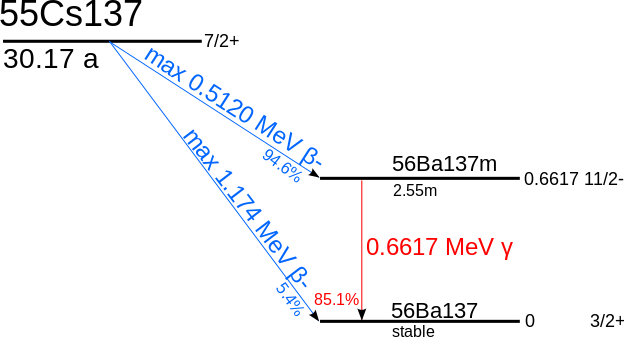
File: Cs-137-decay.svg
Decay pattern of cesium-137 ( from here )
It should be recalled that the cesium-134 has a decay time of two years, for which the presence of these peaks denotes the origin of Fukushima. In other cases the absence of cesium-134 has been used to show how fungi which also had radioactivity above the threshold of 100 Bq / kg were not contaminated by the central, but presumably from previous nuclear tests.
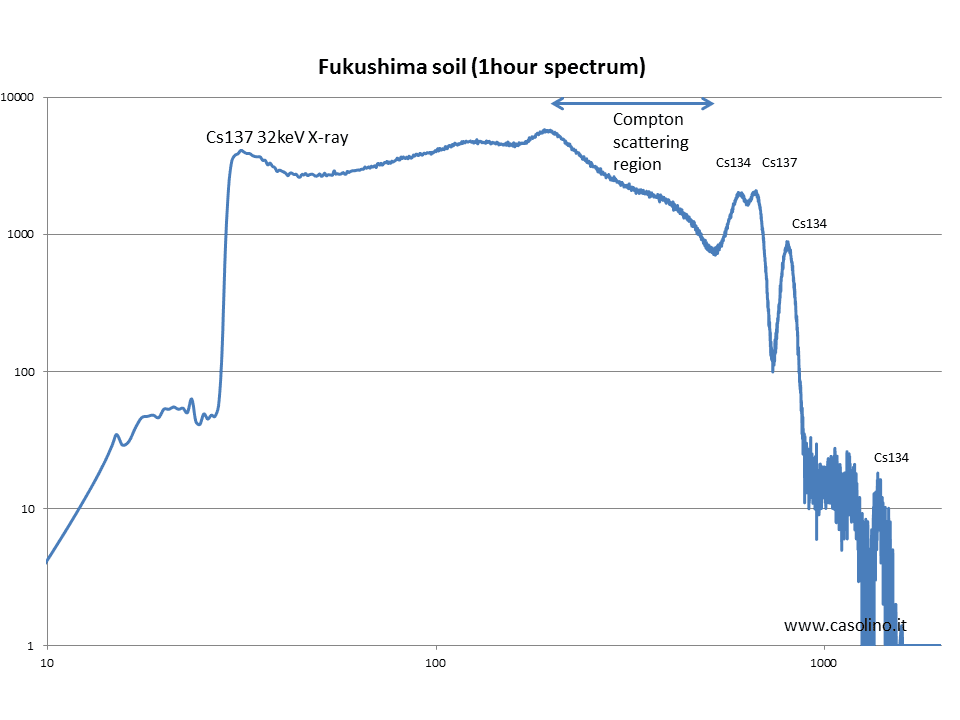
Gamma spectrum emitted by a sample
soil of Fukushima region.
From the decay probabilities  and the height of the peaks can be traced to the relative abundances of different isotopes. Reconstructing the absolute activity of a given sample in Bq / kg is much more complicated because it is necessary to take into account the geometry and efficiency of the detector: it will be the subject of a future post.

lunedì 30 aprile 2012

Nuclear Plants, Radiation and Food in Japan - updates

Currently in English, Italian translation will follow. 

Power Production

No electricity is generated from nuclear plants in Japan. All but one reactors are down, officially for maintenance. Whether they will be reactivated is still debated. Oki reactors are now less likely to be put back on line, pending the complaints by local government and some still unclear safety issues.

As of now, both Kanto and Kansai (that are on different grids) are consuming about 80% of the full power production. If this figures are correct, there is the clear possibility to have scheduled black-outs this summer, especially if it will be warmer than last year. The situation might be more critical for Kansai  which had a larger nuclear-produced energy fraction and that last summer had still the nuclear power plants online. 

Environmental radiation in case of no decontamination
in 10 and 20 years from now


Environmental radiation


Outside the exclusion zone, Japan has  an average  lower environmental radiation than Italy.  
Recent simulations show that - in absence of any decontamination - the Fukushima expelled Cesium will leave the exclusion zone unsafe for more than 10 years. This is hardly surprising given the 30 years half-life of Cesium 137. Decontamination strategies are under study, either by removing the ground, by letting radiation penetrate deepen in the soil in case of hot spots, or by physically separating the radioactive material from the rest. A truck from Toshiba has been set up to demonstrate the principle. The first method seems more expensive but is much more reasonable,  provided that all the material is stored around the site of the now destroyed power plant. The truck option would be the cleanest one, but cost of the procedure and the possibility of large scale production are not clear. 


Is there radiation in food in Japan?

A vegetable wholesaler has been found relabeling the origin of Fukushima cucumbers in other prefectures. He was just scolded, no fine or charges. The cucumbers were not dangerous in themselves, since it still is below the new limit of 100Bq/kg for Cesium, but the lack of legislation is worrying. This new lower limit (previously was 500Bq/kg) is causing a lot of trouble to fruit and vegetable companies, since the value is extremely low too meet. .  All food (and our body) contains radioactive material: as a reference it is worth remembering that bananas  have 125 Bq/kg of  Potassium 40 (even though it is expelled faster from the huma. body).


Left and right: radiation data of Coop food products

All are below the new limit of 100Bq/Kg (mentioned in the top page). The food with highest radiation content are Shiitake mushrooms. Note that Germanium detectors have an higher resolution than those of NaI  and can distinguish between the isotopes of Cs134 and Cs137. 
The total amount of radiation in Ge-measured products is the sum of the two isotopes. Cs134 has a shorter half-life, two years, compared to the 30years of Cesium 137, so it is expected that Cs134 content will be negligible by next year.


Rate of disappearance of Cesium from human body
from here
 

venerdì 13 aprile 2012

TEPCO Electricity production in Japan before and after the Tohoku Earthquake 1) general analysis

Note: this blog is usually in italian: I've been asked to write this post in english to make it more widely available. The italian version is below. 

In the frenetic months after the  Tōhoku earthquake, the struggle to keep Fukushima power plant under control was mirrored by a quieter, but equally dramatic effort to contain Japan electricity consumption within limits.
Drop in power production immediately
after the  Tōhoku  Earthquake.
Calo di produzione di energia elettrica immediatamente 
dopo il terremoto.
All nuclear power plants  went in safe mode at the beginning of the seismic activity, around 14:46. The drop in electricity  production is about 30%, from 38GW to 27GW. It took a few days for power production to grow back to 35GW. Even though rolling blackouts started officially only on March 14th, the lower power consumption during both day and night is clearly visible immediately after the earthquake.
Comparison of power  production in 2010 and 2011
note the sharp drop after March 11 and the effect of rolling
blackouts and power saving.
Confronto di produzione di energia elettrica nel 2010 e 2011 
notare il forte calo dopo il 11 marzo e l'effetto del  risparmio energetico e dei

black-out programmati.
As fossil fuel production was increased to compensate for the shut down of many nuclear power plants all over Japan, both public and private sector had to reduce energy consumption by at least 15%. Every day TEPCO produced real-time graphs which showed the maximum available power vs the power consumption (here, in italian). In autumn TEPCO officials admitted that there had been a "mistake" in these estimates and that actual power production capability might have been higher. With historical data now available from the TEPCO website we can estimate the effect of the Tōhoku earthquake from the power production standpoint. 


Power saving procedures and a cooler Summer (2010: 24-37oC, average 27-33 oC, 2011: 19-35oC, average 25-31 oCkept the power usage within acceptable limits until the end of the 2011, where the difference  with the previous year was not so big. In 2012 the lower power consumption is still evident but not so significant. However a hot summer might require more  energy than what can be produced with conventional fuels. Almost all nuclear reactors have been taken off the production line, although 2.3GW Oi power plant  (discussed here, in italian) will probably be reopened next week to prepare for  next Summer.  

Comparison of the power production from 2008 to 2012:
nota how the pre-earthquake electricity  consumption is roughly the
same in all years and that the power production levels
 in the first  months of 2012 are very close to the pre-earthquake time.
Confronto tra la produzione di energia elettrica 2008-2012: 
Notare  come i consumi 2008-2010 siano più o meno 
gli stessi e come  i consumi dei primi mesi del 2012 
siano quasi pari ai livelli pre-terremoto


Versione in italiano

Nei mesi frenetici dopo il terremoto del  Tōhoku , la lotta per mantenere la centrale elettrica di Fukushima sotto controllo è stata rispecchiata da uno sforzo più nascosto, ma ugualmente drammatico per contenere il consumo di elettricità del Giappone entro i limiti.
Tutte le centrali nucleari sono andate in sicurezza  all'inizio dell'attività sismica, intorno alle  14:46. Il calo della produzione di energia elettrica è circa il 30%, da 38GW ai 27GW. Ci sono voluti alcuni giorni perchè la produzione tornasse a 35GW. Anche se i blackout programmati sono iniziati ufficialmente solo il 14 marzo, il minor consumo energetico durante il giorno e di notte è chiaramente visibile subito dopo il terremoto.

Anche se la produzione di combustibili fossili è stata aumentata per compensare la chiusura di molte centrali nucleari in tutto il Giappone, sia il settore pubblico che quello e privato hanno dovuto ridurre il consumo energetico di almeno il 15%. Ogni giorno la TEPCO produceva in tempo reale grafici che mostravano la massima potenza disponibile rispetto al consumo di energia. In autunno i funzionari della compagnia hanno ammesso che c'era stato un "errore" in queste stime e quella attuale capacità di produzione di energia elettrica sarebbe stata più alta. Con i dati storici sono ora disponibili dal sito web di TEPCO possiamo stimare l'effetto del terremoto del Tōhoku dal punto di vista della produzione di energia elettrica.
Grazie alle procedure di risparmio energetico ed un'estate non troppo calda (2010: 24-37 ° C, media 27-33 o C, 2 011: 19-35 ° C, media 25-31 o C) è stato possibile mantenere il consumo energetico entro limiti accettabili sino alla fine del 2011, dove la differenza con l'anno precedente non era così grande. Nel 2012 il minor consumo energetico è ancora evidente, ma non molto significativo. Tuttavia, una calda estate 2012 potrebbe richiedere più energia di quello che può essere prodotta con combustibili convenzionali. Come già accennato qui, quasi tutti i reattori nucleari non producono più energia  anche se la centrale elettrica da 2.3GW di Oi  sarà probabilmente riaperta la prossima settimana per preparare la prossima estate.